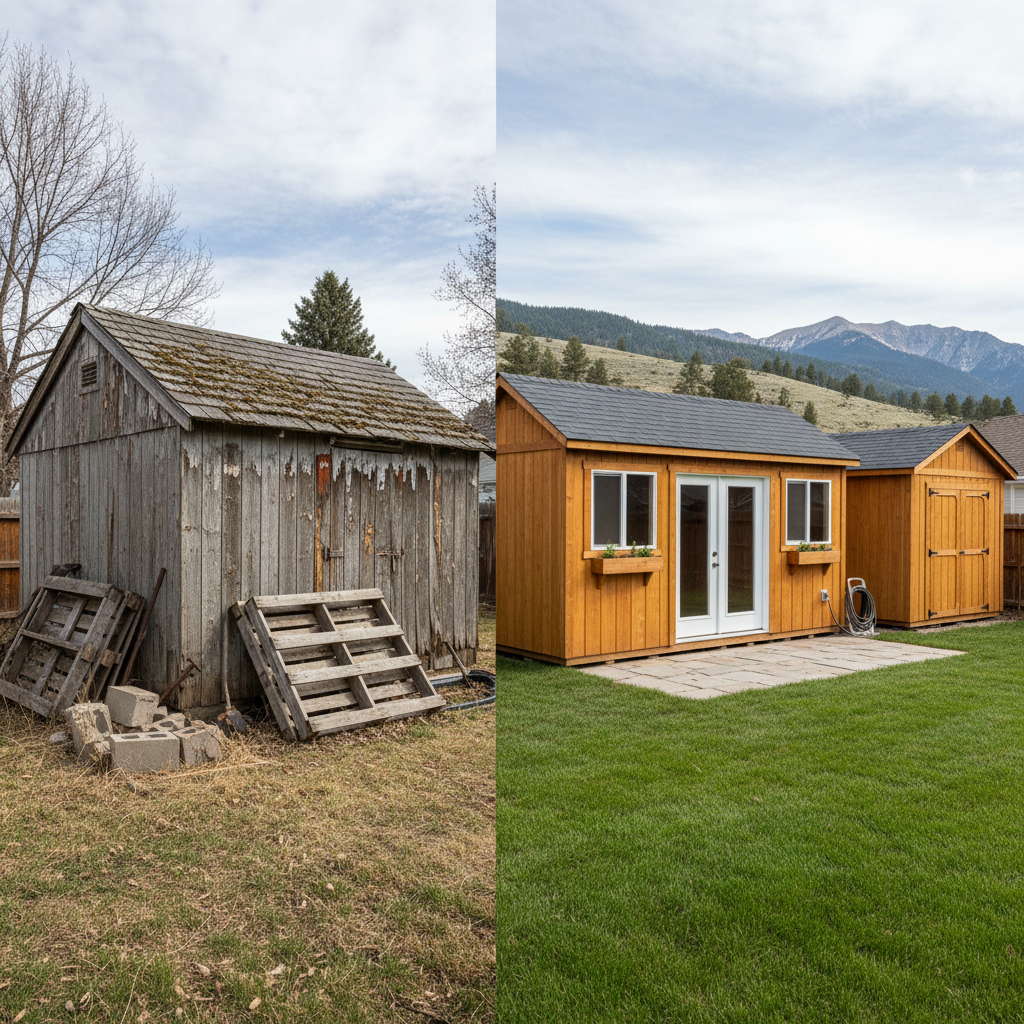
Choosing how to get a new storage building on your property usually comes down to a choice between two main routes: having a pre-built unit hauled in on a trailer or building a custom structure right where it sits. If you live around Great Falls, you already know our weather does not cut anyone any slack. Between the heavy snow loads off the Highwood Mountains and those sudden winds whipping across the plains, your choice matters more than just how it looks from your kitchen window.
Upfront Costs and Hidden Fees
Prefab sheds look attractive on the wallet at first glance. You pick a model off a lot, write a check, and they drop it on your gravel pad. But you have to watch out for delivery logistics. Getting a massive wooden box down tight neighborhood streets in the Black Eagle area or navigating a sloped backyard can turn a simple drop-off into an expensive headache.
Site-built options cost more upfront because you are paying for skilled labor, local framing, and materials brought in piece by piece. Yet, you are not paying for specialized transport machinery or risking damage to your landscaping. Custom Sheds Great Falls finds that framing things by hand often saves money on workarounds that prefab units require when your site is not perfectly level or accessible.
Durability Against the Elements
Pre-built sheds are built to travel down US-87 at fifty miles an hour. That means they have to be engineered light and flexible enough to handle highway transit stress. But once they face a brutal Cascade County winter with sub-zero temperatures and heavy snow stacking on the roof, that flexibility can translate into tweaked frames and jammed doors.
When you build on-site, the structure anchors directly into a solid foundation tailored to your exact yard. We use heavier dimensional lumber, tighter fastening patterns, and strong roof trusses designed specifically to withstand local snow loads without buckling. There is no compromise made for highway transport.
Maintenance and Long-Term Value
Maintenance largely depends on materials, but installation quality plays a huge role. Prefab units sometimes use thinner siding or economy-grade trim to keep factory weights low. Out here in the dry Montana sun and freezing winters, cheap materials warp and peel fast.
A custom-built structure lets you choose every single component. You can match your house siding, specify heavier roofing shingles, and ensure proper ventilation so condensation does not rot your gear from the inside out. It becomes a permanent asset to your property rather than a temporary fix.
If your yard has easy access and you need cheap storage fast, a prefab drop might do the trick. But if you want something that stands shoulder-to-shoulder with our local winters year after year, building on-site is the way to go.